
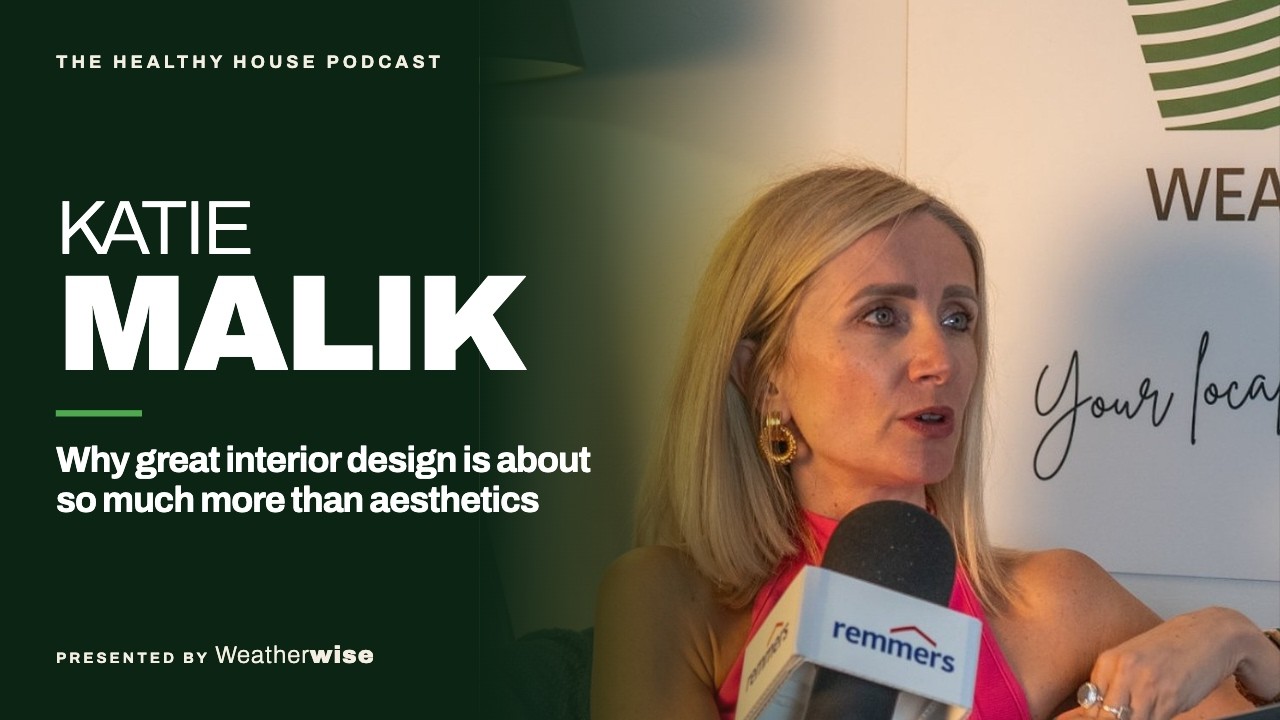
Why great interior design is about so much more than aesthetics
What makes a house truly feel like home? In this episode of The Healthy House Podcast, we’re joined by award-winning interior designer Katie to explore how the spaces we live in influence how we feel, and why good interior design goes far beyond appearances.
- Episode
- No. 11
- Published
- Length
- 1 hr 11 min
- Guest
- Katie Malik, Katie Malik Design Studio
This episode on


What this episode covers
What makes a house feel like home? In episode eleven of The Healthy House Podcast, host Aaron Worrall talks to award-winning interior designer Katie Malik about how the spaces we live in influence how we feel, and why good interior design goes a long way beyond appearances. It is a long, unhurried conversation of just over an hour. It covers how Katie got into design and built a business, how a designer works with a client, the traps of Pinterest and AI, what interior design costs and when to hire one, how to make a small room feel bigger, and Katie’s rules for a bedroom.
From linguistics and teaching to interior design
Katie did not start out in design. Katie studied linguistics and worked as a teacher and lecturer before making what Katie calls a huge career shift. Interior design goes back to childhood, when Katie would redraw the little blueprints in magazines a parent brought from abroad. Learning languages from scratch took discipline, resilience and organisation, Katie says, and those carried over into the business. Katie also describes the awards as the result of hard work rather than a plan: the application process involves preparing packs, sending samples and explaining the rationale and budgets, and it does not happen overnight.
Katie worked for studios in London and soon realised that serving a certain type of clientele was not the aim and that Katie wanted to do things their own way. Katie believes everybody deserves a beautiful, healthy home, not just people at a certain income level. Running real projects showed that it was far more than sitting at a desk, and with no business training, Katie signed up for training and a mentoring scheme. Nobody at school teaches cash flow or accounts, Katie says, and finances still make them a little anxious. The business began with a website and a daily blog written on the commute, which brought the first projects, and Katie then left the job to commit to them. Katie adds that it started organically, from daily effort and passion rather than from targeting a type of client.
Start with how you want to feel
How do you take a picture in your head to somebody’s emotion? Katie says part of the gift is listening, communication and empathy: you cannot be a good designer without them. Most residential clients want to feel a certain way, Katie says. They want to come home and feel at peace, to relax, to move easily, and some want to entertain. Taking the feeling and letting it lead the choices is behind everything Katie does.
Katie says some schools teach designers to interview clients by collecting data such as age and job, which Katie finds irrelevant: it matters more to understand how you want to feel at home. The look can be shown in pictures, but the feeling is the point, and what we have physically in our homes is the source of it. Some clients have deeper stories, Katie says. One moved to a new part of the UK after a major life change, looking for a certain feeling as well as functional rooms, and kept one chair that had been used to read to the children. It was reupholstered and became an important piece in the scheme because it brought back memories.
Colour, layers and texture
On colour, Katie says that everything goes as long as you love it. There is colour psychology, but Katie thinks it applies more to public spaces: in your own home, Katie separates what colour psychology says from what a client is drawn to, because that is so personal. Orange is very vibrant for a bedroom, for example, but if you love it you could use it in small accessories.
Good design has layers, Katie says: furniture, lighting and fittings, and a mix of plain, texture and pattern. When people try to keep a scheme high-end they often forget pattern and use only plain surfaces without texture. Texture is simply the opposite of plain, Katie explains, like a woven blanket against a smooth table, and Aaron notes that new homes with plastered, painted walls often have no texture or colour.
Furniture, memories and keeping what you love
Clients often ask whether Katie works with existing furniture. Of course, is the answer: you can give a piece a new life, alter it a little, and especially if it is meaningful, make it work with the new scheme. Katie describes a dining set where, depending on how the chairs are built, a new fabric and reupholstery can change the look without replacing anything, and mentions mid-century chairs restored with different cushion fabrics.
Pinterest, Instagram and AI
Pinterest has always been a great source of inspiration, Katie says, though sometimes a bit wild. But Instagram and Pinterest have confused people, because every layout is different and so many choices leave them overwhelmed. Aaron compares it to the jam-jar test, where people given more jams to choose from decide less. Katie says to be honest with clients, explains how the studio works up front, and has recently limited the number of revisions with the visualiser because of the extra work. Katie says they are not an options designer: the right design comes from talking to the client, understanding what they want and creating the best option, then fine-tuning it, and if you want options you can go to AI.
On AI, Katie says the studio uses detailed 3D visuals, not AI-generated ones, because everything is designed down to the materials. AI can do a decent job generating initial ideas, but it cannot understand how you feel unless you tell it, lacks empathy and often gives rooms that are not functional. Katie mentions a friend, a creative director at a high-end kitchen company, who is driven mad by clients bringing AI-generated kitchens that cannot be built.
The bedroom
Most people spend most of their time at home in the bedroom, Katie says, and it is often neglected, with people thinking it is just a bed and some cabinets. There is more to it: colours, textures, the right air temperature, the position and type of bed, the lighting and the mattress. Katie’s golden rules, several of which Katie describes as energy points, are:
- The door should not open directly onto the end of the bed.
- You should have a headboard, not a metal bed, ideally against a solid wall.
- Never have a mirror in front of the bed; if you cannot move it, cover it at night.
- Keep the lighting to the bare minimum, very low before bed, and avoid harsh, cool light.
- Have a mattress that is right for you, which Katie calls a good investment.
Aaron adds a rule of no television in bed. Katie says people often do not realise that their sleep is poor because something in the room does not work, and that most mistakes come from lack of education that anyone can address.
Is a designer for everyone, and when to hire one
Katie calls it a huge misconception that designers are only for high-end projects. Designers are like GPs, Katie says: generalists, not lighting specialists, electricians or painters, who put the elements together, create a design and manage or oversee it, and can bring in specialists. Interior design is a professional service like any other, with fees to allow for in a renovation, though some designers work only with certain clients. If you cannot afford a full package, guidance on the general layout, where furniture and lighting should go, is doable for most people, Katie says, and a full turnkey service is a major investment because of the time it takes. Katie says some clients have told them that their homes sold quickly and for more than they asked, though each person will see the cost differently.
For when to hire, Katie says the biggest mistake is getting a designer too late: buying furniture first and asking a designer to work with it, bringing one in after the electrician’s first fix, or calling when the builder starts next week. Not planning, and rushing into buying, is the biggest mistake. Katie also says not to buy matching sets, and warns about having either too many pieces or too few.
A small room, a small budget and the seasons
Aaron asks how to make a small bedroom bigger. Katie suggests keeping the scheme simple, using a darker or more saturated colour, even on the ceiling, with mirrors, very small side tables, and a tall headboard that draws the eye up. For a small budget, Katie says to spend on accessories and lamps and dress the table rather than buy furniture, and suggests reupholstering chairs or adding a rug. To style a home for the seasons Katie suggests throws, cushions, artwork, plants and decorations, though Katie does not design seasonally, because the home is somewhere you live.
Wellbeing, and public spaces
Katie says good design affects wellbeing, and that clients report being happier and sleeping better after a renovation. Katie hopes more of this thinking reaches public spaces, giving the example of surgeries with harsh lights, hard surfaces and dated colours. Aaron says that when Aaron’s team surveys damp, people calm down when asked how they want the room to look once it is done.
The Healthy House Checklist
Katie’s three tips are to make sure the air in your home is clean, with no mould or wet patches, which Aaron’s work is about too; to remove anything you do not like, such as furniture you have kept only because it was passed on; and to bring in something that does bring you joy. That could be selling a piece you do not love and buying one you do, or a quick upgrade like dressing a dining table, because, Katie says, we underestimate how much little things bring us daily joy.
Who should listen
Anyone renovating, refreshing a single room or wondering whether a designer is worth it will find something here. It will suit people swamped by choice online, anyone planning a bedroom or a small space, and anyone who wants to design a home around the people who live in it.
Brought to you by Weatherwise. Produced by Crawford & Beattie.
Questions this episode answers
Is interior design just about how a room looks?
No: Katie Malik says it is multi-dimensional, looking at aesthetics, the feeling and the functionality together. Katie argues that what we see in our homes is the source of the feeling, and that the feeling is what should lead the design. Katie says clients tell Katie after a renovation that they are happier and sleep better, and that a home that works for the individual has an amazing effect on wellbeing.
Where should I start when redesigning a room?
Start with how you want to feel in the space, says Katie Malik, who says that is behind everything Katie does. Most clients want to come home and feel at peace, to relax and move around easily, and some want to entertain. Katie says the way some schools teach designers to interview clients, with data such as age and job, seems irrelevant; the look can be shown in pictures on Pinterest or Instagram, but how you want to feel is what matters.
Is an interior designer only for expensive homes?
No, says Katie Malik, who calls it a misconception caused by interior design being described as luxurious. Katie compares designers to GPs, generalists who put the elements together and can bring in specialists, and says anyone who is renovating will have professional fees to allow for. Katie says guidance on layout, flow and where lighting and furniture go is the kind of help that is doable for most people, while a full turnkey service is a major investment because it takes so much of the designer's time.
When should I hire an interior designer?
Early, says Katie Malik, who says getting designers too late is a big mistake. Katie describes people who buy new furniture and then ask a designer to work with it, or who bring a designer in after the electrician's first fix, when sockets would have to be moved, or when the builder starts next week. Katie says not planning properly is the biggest mistake of all.
What are the biggest mistakes people make when decorating?
Katie Malik lists buying furniture before planning, getting a designer too late, rushing into buying things and then having to work around them, and having either too many pieces or too few. Katie also says not to buy matching sets, because Katie believes furniture makers invented sets to sell more of the same thing, and that matching bedside tables, bed, chest and wardrobe are not a designer look.
Can I keep old furniture when I redecorate?
Yes: Katie Malik says clients often ask whether the studio works with existing furniture, and of course it does, because you can give a piece a new life or alter it slightly. Katie is especially keen if it has good memories, and says a dining chair can be reupholstered in a new fabric to update the look without replacing it. Katie's own example is a client who kept one chair, reupholstered, because it brought back memories.
Can I trust Pinterest, Instagram or AI images to plan a room?
Use them for ideas, not plans, says Katie Malik. Pinterest has always been a good source of inspiration, but seeing so many choices has left people overwhelmed, and every layout is different, so what looks good in a picture may not suit your house. Katie says AI can generate decent initial ideas but cannot understand how you feel, lacks empathy and often gives rooms that are not functional; Katie's studio uses detailed 3D visuals, not AI ones, and Katie says that offering a choice of options is not how the studio works.
How can I make a small room feel bigger?
Katie Malik suggests keeping the scheme simple and using a darker or more saturated colour, which Katie says is counterintuitive, even on the ceiling if you are brave enough, so that there is no separation. Katie also suggests lots of mirrors, small side tables if space is tight, and a very tall headboard, so the eye is drawn up rather than to the floor and the light bounces back.
What are the golden rules for designing a bedroom?
Katie Malik says the bedroom is where most people spend most of their time and is often neglected. Katie's rules, several of which Katie calls energy points, are that the door should not open directly onto the end of the bed, that you should have a headboard, not a metal bed, against a solid wall, that you should never have a mirror in front of the bed, and that lighting should be very low before bed, without harsh cool light. Katie adds that a mattress that is right for you is a good investment.
Who is Katie Malik?
Katie Malik is an award-winning interior designer and the guest on Episode 11 of The Healthy House Podcast. Katie studied linguistics and worked as a teacher and lecturer before changing careers into interior design, an interest that goes back to redrawing the blueprints in magazines as a child. Katie started the business by blogging and building a website, and had no business training, so learned it, and has been through the award application process, which takes a lot of hard work.
What is Katie Malik's Healthy House Checklist?
Katie Malik's three tips are to make sure the air in your home is clean, with no mould or wet patches, to remove anything you do not like, such as furniture you have kept only because it was passed on, and to bring in something that brings you joy. Katie says that could be selling a piece you do not love and buying one you do, or a quick upgrade like dressing a dining table, because we underestimate how much little things bring us daily joy.