
Realistic Property Investing
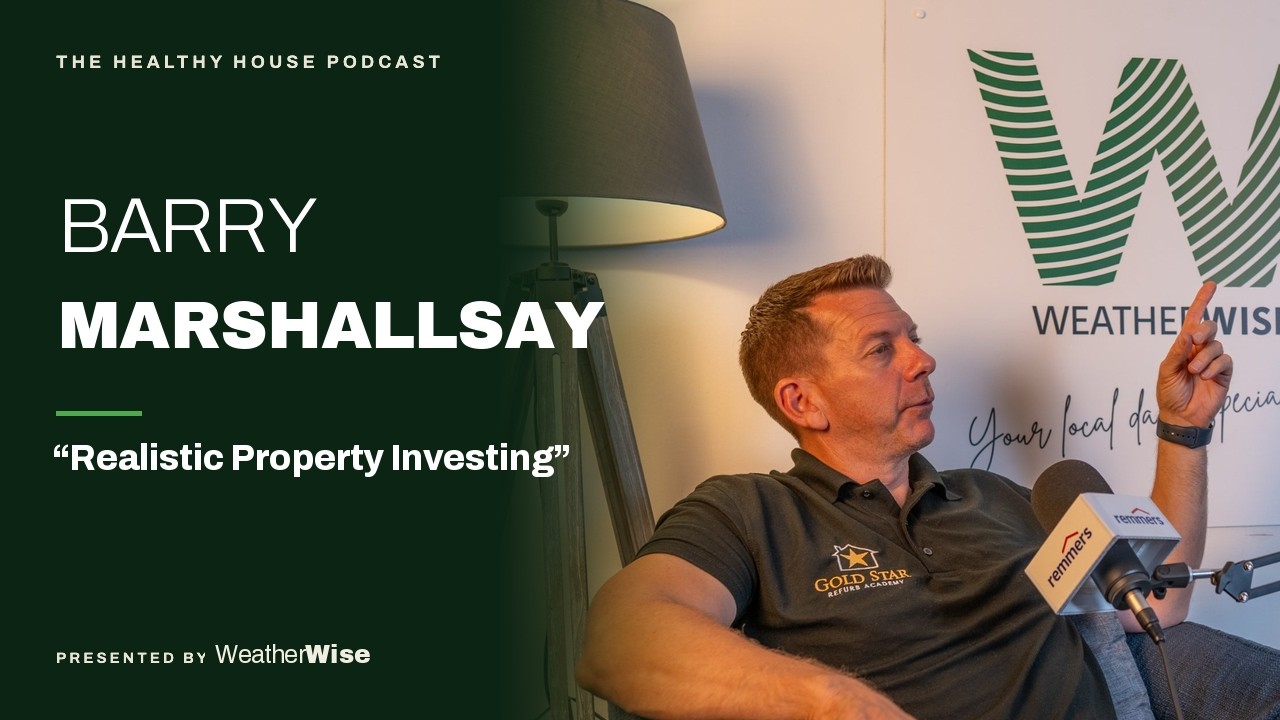
Is property investing really as easy as social media makes it look? Aaron talks to Barry Marshallsay of Gold Star Property Group about the realities of property investment, development and being a landlord.
- Episode
- No. 12
- Published
- Length
- 1 hr 12 min
- Guest
- Barry Marshallsay, Gold Star Property Group
This episode on


What this episode covers
Is property investing as easy as social media makes it look? In episode twelve of The Healthy House Podcast, Aaron Worrall talks to Barry Marshallsay of Gold Star Property Group about the realities of property investment, refurbishment and being a landlord. It is a conversation of just over an hour that is deliberately about the parts that do not make it into the highlights: mortgage shocks, how to buy, how to run a refurbishment, how to work with trades and how to look after a rented home. It is one person’s experience, not financial or legal advice.
The side social media does not show
Barry does not hold back on social media. It is a massive sales machine with a lot of lies, Barry says, such as the claim that you can do property in four hours a week. There are nice sides, including flexibility, but the glamorous version leaves out dragging a mattress to the tip and a washing machine that always seems to break down on a Friday night or just as you pack the car for a weekend away. Barry also says standard buy-to-let is not a get-rich scheme: many earn very little, and some cost the owner money each month, so it is a long-term investment with a gamble in it. Barry shows mistakes on social media too.
From pizza stores to a first auction purchase
Barry came to Stoke-on-Trent in 2005, and after the family sold their Domino’s Pizza stores in 2013 they had money for the first time. They went to an auction with no idea what they were doing, won a property and refurbished it with no idea how much it would cost or how long it would take, making it up as they went along. Property was meant to be somewhere to park some cash before a move abroad. Later, back in the UK with another stressful business, Barry remembered how much they had enjoyed the property, booked a two-day property event and signed up for education. They have now been in property for six years.
When mortgage rates rose: buy-to-let to HMOs
Barry is open about a mistake. Rates had been dropping when they took out two-year deals, and then rates rose sharply just as every one of those deals ended, so profits roughly halved. They had always said they would never touch HMOs, but they needed a strategy that returned higher cash flow, and moving into HMOs was a game changer. An HMO, or house in multiple occupation, is let by the room. Barry’s rooms have en suites and a small tea station, and the bills are included, which Barry says is value for money for the tenant. Aaron notes that fire doors in HMOs mean ventilation has to be thought about, because the house does not work as it normally would.
What to buy: the worst house on the best street
Barry’s rule is to buy houses nobody else wants to live in. A house that looks good and is okay carries a premium, so Barry looks for the worst house on the best street, such as a smelly, damp or mouldy one. Many investors are scared of damp because they do not know what to do, so for Barry it is a bargaining tool if you know how much it will cost to put right. Barry does not look at structural issues, because there are too many unknowns to price when you are not a builder. Barry also takes a negative approach to viewings, looking for all the reasons not to buy to avoid getting emotionally involved, then going back for a second viewing to look for what was missed. If nothing turns up and the numbers still stack up, it is time to move quickly. Where a property is going through the legal process, Barry sometimes arranges to take the trades round again.
Aaron asks about surveys and says buyers who skip them often find problems they did not know about. Barry says that on a tired house a survey will not tell much, because it is a tip, though Barry would want one on a nice house. Aaron says people going in without Barry’s experience definitely need the professionals.
Planning the refurbishment before you collect the keys
Barry describes project management as the area of expertise. The first refurbishment took about six months, with Barry asking whether anyone knew a plasterer when it was needed and stripping out skirting boards and doors that were fine. Now, Barry says, a typical three-bed semi takes about six weeks. A recent one took longer because of a ground issue under the house, red ash, which had to be dug out, and the concrete above it was unusually thick and steel-reinforced.
Before the keys are collected, Barry takes the trades to view the property, gives each an itemised list of jobs, and finds out what each needs before starting, how long they will take and what materials they need. A rough project plan is then built to fit the completion date, so on the first Monday the trades are in. Barry uses systems and spreadsheets to work out quantities and costs, copying across from earlier jobs, and says a six-bed HMO refurbishment came in for less than the surveyor and broker said it would. The schedule of works is a live tool: if the budget is tight you change the specification, for example using panels in the shower area instead of tiling the whole bathroom, and see what you save. If you are using bridging or development finance, Barry says you must be confident of finishing on time because overrunning has big consequences.
Working with trades
Barry says investors blame trades for everything and rarely say they got it wrong. The responsibilities run both ways: give a trade the days they need together, have the job ready, have the materials on site and pay on completion when you are happy. Barry says the trades will travel for someone who project manages, because they know the job will be organised. Aaron, speaking as a contractor, says the biggest message to investors is to use trades wisely: those who squeeze everything to the cheapest price end up paying more in the long run and ruin their reputation with trades. Both say trades look after those who look after them, with Aaron adding that a trade who knows payment will be slow will not give up a weekend. Barry says investors who hand money to someone who has never visited the property see costs run away, and that cheapest does not always work out as value for money.
Know your numbers, and walk away
Barry says to keep emotion out of an investment: you get emotional about your own house but not about an investment. Run the numbers and see whether the project will make money or how much you will leave in. Numbers should make you walk away, Barry says, and so should structural issues or anything where Barry is guessing and has nobody to help. Barry says that rather than risk, Barry would go forward slower. Aaron adds that most of the damp problems Aaron sees in rentals could be avoided with simple maintenance, such as resealing a bath.
Education, knowledge and mentors
Barry values education but says you should narrow down what you want to learn rather than buy everything, and that smaller educators may suit better than big ones. There are serial educators who educate and never do anything. Education is theory, Barry says; knowledge comes from experience, like knowing that a product is wrong for the particular cause of a damp problem. People need a mix, and a mentor helps, as does a network: there is always someone ahead and someone behind you. Barry says that if you are not passionate about property you should not get involved, because it takes over your life, and that people who think one or two deals will bring life-changing money are taking a risk. Barry prefers slow and steady.
Being a landlord
Barry looks after properties for selfish reasons: a well-maintained house keeps its rent up, keeps tenants happy and costs less when tenants change. The HMOs are inspected every three months, with the same paint and colour schemes in every house for touching up and the silicone in showers checked and replaced if needed. Barry says a good landlord might put about 10% of rent aside for maintenance. Large HMOs are valued like a business on what they earn, so letting one run down can lower its rents and its valuation.
Choosing tenants matters, Barry says. The person who runs lettings asks enquirers to say a little about themselves, and tries not to mix tenants with very different routines. Barry says many landlords, especially accidental ones, do not realise how many new rules are coming for landlords, with big fines for those who do not know them. Barry also warns that limited-company buy-to-let usually still needs personal guarantees, so the family home can be at risk if things go wrong.
The Healthy House Checklist
Barry’s first tip is to get some education in whichever strategy you choose, whether buy-to-let, HMOs or serviced accommodation, making sure it is correct and factual; there are free webinars and you do not need loads. The second is to learn how to project manage and understand your project, even if you do not manage the whole refurbishment. The third is to build a network of people who can help, because at some point you will need help. Barry adds that if you see an issue, jump on it quickly and get advice quickly, because it is usually quicker and cheaper to solve than to sit on, and says that without education, project management and a network, it is a very lonely game.
Who should listen
Experienced property investors, first-time landlords and anyone thinking about property development will find a candid look at the unglamorous side here, as will tradespeople who work for investors. This is one person’s experience, not financial or legal advice, so take professional advice on your own circumstances.
Questions this episode answers
Is property investing as easy as it looks on social media?
No, says Barry Marshallsay: social media is a massive sales machine with a lot of lies, such as the claim that you can do it in four hours a week. Barry says there are nice sides, such as flexibility, but also the side people do not see, like dragging a mattress to the tip and the washing machine breaking down on a Friday night. Barry also says buy-to-let is not a get-rich scheme and that many standard buy-to-lets now earn little or even cost the owner money each month.
Who is Barry Marshallsay?
Barry Marshallsay is a property investor from Gold Star Property Group and the guest on Episode 12 of The Healthy House Podcast. Barry came to Stoke-on-Trent in 2005, and after the family sold the Domino's Pizza stores they had run in 2013 they bought a first property at auction with no idea what they were doing. A property training event some years later changed their plans, and Barry says they have now been in property for six years, moving from buy-to-let to HMOs, with project management as the main skill.
What is an HMO and why did Barry move into them?
An HMO, or house in multiple occupation, is a property let by the room to several tenants. Barry Marshallsay moved into them because the profits on standard buy-to-let roughly halved when mortgage rates rose just as the family's two-year deals ended, and they needed a property strategy that returned higher cash flow. Barry says the rooms have en suites and a small tea station, the bills are included, and the tenant gets value for money.
How do rising mortgage rates affect buy-to-let investors?
They can cut profit sharply, according to Barry Marshallsay, whose own profits roughly halved when all the family's two-year mortgage deals ended around the same time that rates rose sharply. Barry says they had signed up for two-year deals because rates had been dropping. That experience is why Barry says to have a strategy that returns enough cash flow.
What should I look for when buying an investment property?
Barry Marshallsay says to look for the worst house on the best street, a house that nobody else wants, because a house that looks good carries a premium. Barry says that when viewing, look for all the reasons why you should not buy it rather than why you should, to stop getting emotionally involved, and go back for a second viewing to look again. If you cannot find a reason and the numbers still stack up, move quickly. Barry avoids structural problems because there are too many unknowns to price.
Is a damp house a good buy for an investor?
It can be, says Barry Marshallsay: a lot of investors are scared of damp because they do not know what to do, so a damp house can be a bargaining tool if you know what it will cost to put right. Barry says damp or a smell makes a house that nobody else wants. Barry also says that knowing the cause of a damp problem matters, because the wrong product for the cause will not fix it, and that this is knowledge that comes from experience.
Do I need a survey when buying an investment property?
Aaron Worrall urges people to pay for a survey, saying that buyers who have bought without one then find problems they did not know about. Barry Marshallsay says that on the tired houses bought for refurbishment a survey would only tell Barry it is a tip, so Barry does not always get one, but that if buying a nice house Barry would want one, and that someone who buys a nice house to rip apart is probably paying a premium. Aaron says people going into it blind, without Barry's experience, definitely need the professionals.
How do you project manage a refurbishment?
Barry Marshallsay plans before collecting the keys: about two weeks beforehand Barry takes the trades round, itemises the jobs for each trade and asks what they need doing first, how long they will take and what materials they need. Barry then builds a rough project plan that fits the completion date, so the trades start on the first working day. Barry uses spreadsheets and a schedule of works as a live tool to find savings, and says the plan has taken a typical three-bed semi from months to about six weeks.
How should property investors treat tradespeople?
Barry Marshallsay says Barry loves the trades and wants to get rid of them as fast as possible, because when they finish Barry gets paid. Barry's approach is to ask the right questions, have the job ready, give the trade the days they need together and pay on completion when happy with the work. Aaron says investors who squeeze everything to the cheapest price end up paying more and wreck their reputation with trades, and that trades repay those who pay on time by going the extra mile.
What are the biggest mistakes property investors make?
Barry Marshallsay says the biggest is thinking you can wing it, along with taking the wrong advice, not concentrating on the numbers and paying whatever it takes. Barry warns that even with a limited company, buy-to-let lenders usually ask for personal guarantees, so the family home can be at risk, and that people expecting life-changing money from one or two deals are taking a risk. Barry also sees investors hand money to someone who has never visited the property, and the costs run away.
What is Barry Marshallsay's Healthy House Checklist?
Barry Marshallsay's three tips for anyone getting into property are to get some education, to learn how to project manage and understand your project, and to build a network of people around you. Barry says education should be correct and factual, free webinars count, and that you do not need loads, but that you need knowledge from real experience too, so a mentor helps. Barry adds that if you see an issue, jump on it quickly, because it is usually quicker and cheaper to solve early.