
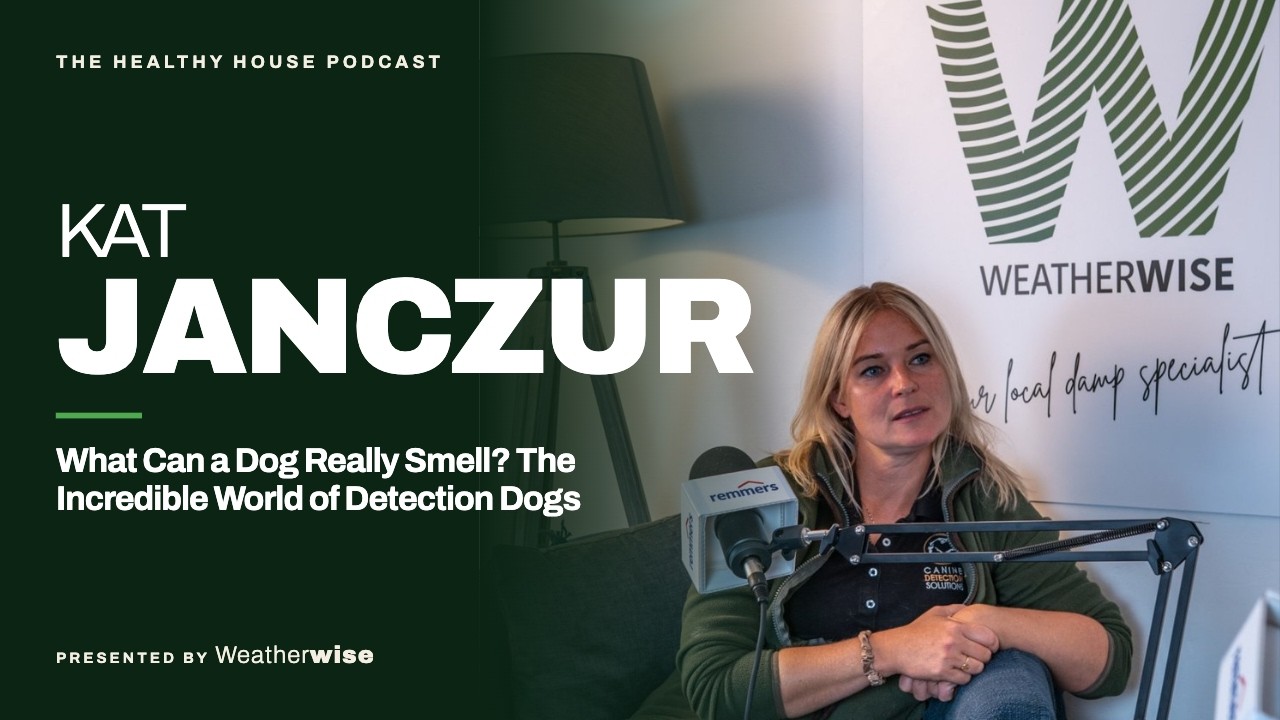
What Can a Dog Really Smell? – The Incredible World of Detection Dogs
Could a dog uncover a hidden problem on your property that the human eye can’t see? In Episode 10 of The Healthy House, we’re joined by Kat to explore the fascinating world of detection dogs and their role in finding Japanese knotweed, supporting property surveys and protecting…
With Kat Janczur, Canine Detection Solutions
What this episode covers
Could a dog find a problem on your property that you cannot see? In episode ten of The Healthy House Podcast, host Aaron Worrall talks to detection dog handler Kat Janczur about how dogs are trained to find a specific scent, how they find Japanese knotweed rhizomes underground, and how they work alongside surveyors on property and construction sites. It runs for about an hour and a quarter and moves from knotweed to waxcap fungi, bed bugs, water leaks and the possibility of dogs finding dry rot.
How Kat came to detection dogs
Kat started in dog behaviour, then went to a workshop run by a Dutch scent-detection company and fell in love with training dogs to find substances. Before knotweed, Kat trained dogs for narcotics, explosives, cadavers and bed bugs. After working with an explosives detection company in the UK, Kat wanted to go back to working for themselves, and about seven years ago a friend who ran a company searching for dry rot with dogs suggested knotweed. Kat had never heard of it. Training began during lockdown, using knotweed found within walking distance, and Kat then started contacting knotweed companies. One researcher was sceptical until the dogs found an area of lawn that had been treated years earlier, where the knotweed had been dormant and his own maps showed where it was.
The dog Kat brought to the studio came from a pound, terrified of everything, and now works searching for waxcap fungi.
How a knotweed dog is trained
Kat prefers to start with puppies, who live in the house with the other dogs, so that the dog can be matched to the team and does not learn to chase wildlife, and looks for working-line dogs bred to work with humans. The dogs are trained on knotweed rhizomes but also learn to find the plant above ground. Training takes a long time, partly because the dogs need to meet the plant through its whole life cycle. The dog is rewarded for the scent, usually with a red Kong, and learns that finding knotweed and showing it, by sitting or lying down and holding the position, gets the reward. Any dog can enjoy searching as a hobby, Kat says, but a working dog has to do it in bad weather and when tired.
Kat is careful to train the dogs only on knotweed. If a dog also knows other plants, you cannot be sure underground what it is indicating on. Kat would not trust anyone who says their dogs can find twenty invasive species. Training also has to avoid the dog learning to respond to soil, so the dog is exposed to other roots with soil on them that are never rewarded.
The Wales case: 44 locations
Kat describes a development site in Wales where experienced surveyors, helped by historical images that suggested knotweed should be there, had surveyed the site and dug exploratory pits but found nothing. Kat did a human survey first and saw nothing either. The first dog found a large piece of rhizome very quickly. It looked like a black root on the spoil from the digs, so it was easy to miss, and Kat had walked past it. The dogs went on to find 44 confirmed locations, including in parts of the site that had been judged clear. Kat stresses that it was 44 locations, not 44 pieces, and that there were many more pieces. Had it been missed on a new-build site, Kat says, there were many viable rhizomes that would have started growing when disturbed, in people’s new gardens and next door, and if soil had been taken off site it could have infested other places.
What a survey looks like on the day
Kat arrives and does a human survey first, to look for anything dangerous for the dogs and for areas that cannot be searched, and to plan around weather, terrain and wind. The dogs search one at a time for up to 30 minutes, then rest for at least as long as they searched. A dog shows a find by sitting or lying down. If a digger is on site, it digs where the dogs have indicated; otherwise Kat might hand-dig, and anything that cannot be confirmed is recorded as an unconfirmed indication, when Kat brings in the other dogs. Kat tracks everything on an app and writes a report, which includes the limitations: a rubble area full of glass, concrete over soil, or clay that may affect how well the dogs perceive the scent. Kat has worked alongside diggers, searching the hole after the soil settles and searching the machine at the end of the day.
Limits, testing and choosing a surveyor
Kat is clear that dogs have good and bad days and that weather and soil affect them. They are an extra service, not a replacement for human surveyors, and Aaron likens it to how they talk about AI: it is cooperation. Dogs are tested using line-ups of pots, where the dog has to find its target among distractions and ignore everything else, and with real-life searches where nobody present knows where the knotweed is, because dogs read body language even when you do not mean to give any cues. Every dog is tested once a year, alongside continuous training.
Because the field is not greatly regulated, Kat says to ask how the dogs are trained and how they are tested, to want the dogs trained only on knotweed, and to be suspicious of anyone who says their dogs always find everything. Nothing alive is 100%, Kat says, human surveyors included.
What knotweed looks like, and why dogs help
The leaf is flat across the bottom, a bright green almost heart shape with straight sides, and underground the rhizome is usually dark orange when broken and often breaks like a carrot. Surveyors rely on those visual cues, whereas dogs go by scent. Kat says that younger rhizome may not be as orange, and that a dock root can look suspiciously orange but is clearly not knotweed to a dog.
Buying a house or land
Kat says evidence of knotweed can make it hard to get a mortgage or to sell, and tells of a seller whose buyers’ bank twice refused after a surveyor flagged a tree root as possible knotweed; a specialist company’s report that it was not knotweed was not enough, and the bank asked for the dogs. For a house, Kat suggests checking how high the risk is in your area, looking at historical images if you suspect something is wrong, and bearing in mind that a neighbour who has it, odd activity on the site or topsoil of unknown origin raises the risk. Kat would not say every house needs a proper knotweed survey, and in a straightforward case a human survey may be enough. For land you plan to build on, Kat would get a dog survey, partly to find out how bad it is before deciding whether the excavation is worth it.
How knotweed spreads, and dealing with it
Kat wants people to understand how invasive it is and how easily it spreads. Disturbing the ground makes it grow, imported topsoil can bring it onto a site, and a digger can carry small pieces to another one, which is why Kat searches machines before they leave site or move between clean and dirty areas. More companies are being proactive about this biosecurity, Kat says, rather than calling after things have gone wrong. Most of the plant is underground, Kat says, like the tip of an iceberg. Soil that carries knotweed has to go to a licensed landfill, and if someone offers a cheap price for removal, Kat says to query it. Kat also says it is hard to know whether knotweed is dead or dormant.
Waxcaps and conservation
Kat’s dog is helping with a project to see whether dogs can find waxcap fungi, a mushroom some species of which are rare and grow only in very specific environments, so that pipeline routes can avoid biodiverse meadows. The dog can find the underground mycelium as well as the fruiting body, and on one search found a fruiting body smaller than a fingernail in tall grass that a human surveyor had no chance of finding. It is hard to train because the sample is available only in season. Kat says the results so far look very promising and that no one had done it before. Kat also mentions dogs searching for bat carcasses at wind turbines.
Bed bugs, water leaks and dry rot
Kat says dogs are used to find live bed bugs, not dead ones, in hotels and on planes, and that there are dogs that pinpoint leaks in water pipelines. Dogs have also been used to find dry rot: Kat’s friend’s company used them in listed buildings, for example to find dry rot behind a marble wall in a bathroom. Aaron, who does dry rot surveys, says it is often impossible to say exactly where it is until something is taken apart, and that is where a dog could help. Kat is looking into training dogs for dry rot and believes it should be possible as long as the scent can come out through some opening, though if a space is airtight the dog would struggle.
The Healthy House Checklist
Kat’s first tip is to understand your environment: is there knotweed in your neighbourhood? There is an online heat map from one of the knotweed companies, Kat says, and local surveyors may know. The second is to look online at what it looks like so that you recognise it. The third is not to try to deal with it yourself: do not cut or mow it, because that makes it come back, and speak to a specialist, using only legal products if you do treat it, never anything off label.
Who should listen
Anyone buying a house or land who has heard of Japanese knotweed and wants to know what a detection dog survey involves and what it cannot promise. Surveyors and developers will also find the discussion of searching diggers, importing topsoil and testing the dogs useful. And if you simply like dogs, Kat’s stories are worth the time.
Questions this episode answers
Can a dog really find Japanese knotweed?
Yes, says Kat Janczur: dogs are trained on the scent of the knotweed rhizome, the underground part, and can also be trained to find the plant growing above ground. When a dog finds it, it sits or lies down and holds that position so the handler can see where it is. Kat explains that dogs go by scent rather than looks, which matters because human surveyors rely on visual signs. In one case in Wales, experienced surveyors had surveyed a site and dug exploratory pits and found nothing, and the dogs found 44 confirmed locations.
What happens during a knotweed dog survey?
Kat Janczur does a human survey first, looking for anything dangerous to the dogs and for areas that cannot be searched, and plans the search around weather, terrain and how to divide the site. Kat works one dog at a time, for up to 30 minutes, and the dog then rests for at least as long as it searched. Where a dog indicates, the spot is confirmed by digging if possible, or recorded as an unconfirmed indication, in which case Kat brings the other dogs to see how they react. The report lists the limitations, such as rubble, glass, concrete over soil or clay.
Are knotweed detection dogs 100% accurate, and how are they tested?
No, and Kat Janczur says that nothing alive is 100%, whether it is a dog or a human surveyor. Kat says to be suspicious of anyone who claims the dogs are always right, and of dogs trained on many plants, because if a dog also knows other plants you cannot tell what it is indicating on underground. A dog's ability is affected by weather and soil. Dogs are tested with line-ups of pots holding the target and distractions, and with real-life searches in which nobody present knows where the knotweed is, because dogs pick up body language. Every dog is tested once a year.
What does Japanese knotweed look like?
Kat Janczur describes the leaf as flat across the bottom, an almost heart shape with straight sides, in a very distinctive bright green. Underground the rhizome is usually dark orange when broken, and most often it breaks like a carrot, though not always. Kat says dogs help because younger rhizome may not be as orange, while a dock root can be dark orange and look suspicious to humans but is clearly not knotweed to a dog. Once you learn to recognise it, Kat says, you can spot it everywhere, and knotweed surveyors can spot it from a motorway.
Do I need a dog survey when buying a house or land?
Not always: Kat Janczur would not say every house needs a proper knotweed survey, and in a straightforward case a human survey may be enough. Kat suggests checking how high the risk is in your area, looking at historical images such as Google Earth if you suspect something is wrong, and calling in dogs when the case is complicated, the history is unknown or you think someone has not told you the whole story. For land you plan to build on, Kat would get a dog survey, partly to find out how bad it is before deciding whether it is worth developing.
Can Japanese knotweed stop you getting a mortgage?
Kat Janczur says that if there is evidence of knotweed on a property you may not be able to get a mortgage or will struggle to sell. Kat gives an example of a seller whose buyers' bank refused twice after a surveyor flagged a tree root as possibly knotweed; a specialist company's report that it was not knotweed was not enough, and the bank asked for the dogs to search the property.
How does Japanese knotweed spread during building work, and how should it be dealt with?
Knotweed spreads in soil and on machinery, says Kat Janczur: disturbing the ground makes it grow, imported topsoil can bring it in, and a digger can carry small pieces to another site. Kat's dogs search machines before they leave site or move between clean and dirty areas, which is quicker than washing down or a human search. Contaminated soil needs to go to a licensed landfill, and Kat says to query a cheap price for removal because there is legislation and you do not want to commit a crime.
Can Japanese knotweed damage a building?
Kat Janczur says there was a belief that it could break through concrete and foundations, but that research has found it cannot. The fresh shoots are very thin, though, and can get through cracks, so a foundation with a crack can be damaged, while one without cracks should not be. Kat also says knotweed spreads easily and that much of it is underground.
Should I try to get rid of Japanese knotweed myself?
Kat Janczur says it is usually much better to speak to a specialist rather than trying to work it out online. People who cut or mow it find it keeps coming back, Kat says, and Kat gives the example of someone who tried to burn it in a bonfire when the temperature was not high enough, so it was still there in the ash. If you do treat it yourself, Kat says to use only legal products and not anything off label.
What else can detection dogs find?
Kat Janczur says dogs can be trained to find almost anything with a smell. Kat's own dog searches for waxcap fungi, including the underground mycelium and a fruiting body smaller than a fingernail, as part of a project to protect biodiverse meadows from pipeline works. Kat says dogs are also used to find live bed bugs in hotels and on planes, to find water leaks in pipelines, and to find dry rot, for example behind a marble wall in a bathroom, and that dogs are used in conservation, for example to search for bat carcasses at wind turbines.
Who is Kat Janczur?
Kat Janczur is a detection dog handler and the guest on Episode 10 of The Healthy House Podcast. Kat started in dog behaviour, then trained dogs to find substances including narcotics, explosives, bed bugs and cadavers with a scent-detection company in the Netherlands, before moving to the UK. About seven years ago a friend who ran a dry rot dog company suggested Japanese knotweed, and Kat went self-employed, training during lockdown. Kat's dogs live in the house rather than in kennels.