
Building Without Limits – Inside the World of High-End Homes & Landmark Projects
What goes into building homes for Premier League footballers and celebrities, and what can it teach you about planning your own renovation?
- Episode
- No. 14
- Published
- Length
- 1 hr 7 min
- Guest
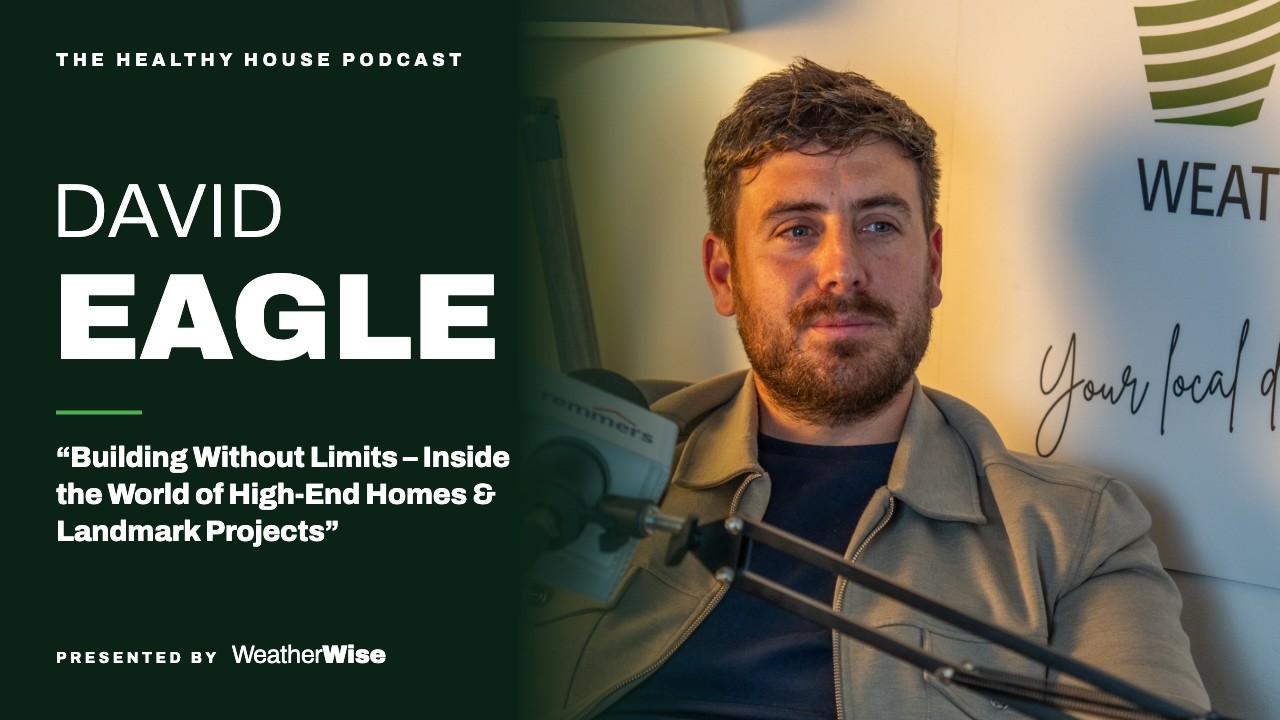
- David Eagle, Eagle Build
This episode on


What this episode covers
Aaron Worrall of WeatherWise sits down with David Eagle of Eagle Build to talk about building homes at the high end of the market, and what that can teach anyone planning an extension or renovation. They cover David’s route from a plumbing apprenticeship to running a construction business, what luxury projects involve behind the scenes, and the decisions that matter on any building job: the team you put together, how you compare quotes, the unexpected costs and why a bigger house is not always the answer. The conversation runs for just over an hour and is relaxed and frank.
From a plumbing apprenticeship to Eagle Build
David left school as, in his words, a nightmare, and was pointed at college by his parents. He chose plumbing over electrics, and found an apprenticeship after a long search. He worked as a plumber on his own, was given a site to run when he pointed out it was not being managed well, and then learned fast on a larger site. He bought a plot or two of his own to develop, but found that without the capital to do it properly the work was hard to staff. The houses he did build were good enough that people kept asking him to price extensions, so he leaned into private work, and Eagle Build grew from there.
He describes the pressure of running the business candidly. Clients are in touch at all hours, he says, and he cannot simply switch off the phone, which is a source of friction at home that the host recognises.
What high-end building asks of a builder
David says working at the top end is about a level of everything: security on site, the standard of the finish and being across a problem before it causes harm. He says the more a client spends on materials, the easier it is to get a sharp finish, but that it is never a job where “that will do” is the attitude, because if something has to be taken out, it has to be taken out.
Security is part of many projects. He describes thinking about panic buttons, alarms and cameras, and one approach to a panic room: a room that looks like any other in the house, with a steel-lined door, a hard-wired internet connection, a hidden panic button and a screen to see what is happening outside. He says the aim is for clients to feel safe without the house feeling like a prison.
Some clients ask for features they have seen in high-end hotels, from fittings to whole rooms, and David says the finish and feel of a good hotel is something many people now want at home. On swimming pools, he says some clients have taken them out because of the heating bills, while at the top of the market they are still expected. Margins on the biggest jobs, he adds, are thinner than people assume.
When things go wrong
Water, as the pair note, does not care how expensive the house is. A leaking balcony above a cinema room is the example they discuss, and they say a problem like that can ruin a great deal more than the part being repaired. David’s approach when something does go wrong is to be honest and apologetic, say it will be sorted, and fix it. He prefers to fix things before telling anyone where he can, and says bad news is better than no news.
They also talk about care. David says in a house like this you cannot assume a client will not mind a mark, and that damage in an expensive home can cost more than the profit on the job. One story is of a client who would not let the team walk across a very expensive carpet, which led to scaffolding being put up to protect it. They discuss how another contractor’s grinding left marks on a car, as an illustration of why you stay alert on a job like this. David also tells the story of a client who wanted a swimming pool refurbished by draining only a little of the water and working from a dinghy he had found online. David says the part below the waterline could be cleaned and regrouted, but the top section needed proper access, so the pool had to be drained.
Start with how you live
The question David asks first is how a family lives. What do you do on a Friday night? Do you eat together? Do you want a cinema room, a barbecue area or a gym? He says a house should be moulded around how people live, and that a cinema room is wasted on a family that never watches films.
That conversation has led him to talk clients out of an extension altogether. If you have a room you never sit in, he says, do something with that room before adding another. He is clear that sometimes a client simply wants a bigger house, and that is fine, particularly for a growing family that needs more bedrooms.
He also asks for a master plan. Think about what you would do if money were no object, he tells clients, then do the first stage now and make sure the footings and structure can take the next one later, such as another storey.
Building the team first
Asked what mistakes a homeowner making an extension should avoid, David’s answer is not planning properly, and not putting the right team together at the start. His advice is to go off the architect’s recommendation. A good architect will normally suggest a shortlist of builders; look at their websites and social media, check the standard of their work against what you want, and only then see where the price lands.
He would not pair a good architect with a random builder they have never worked with. A builder who knows the architect’s drawings can ring and ask for a detail while on site, and the project holds together. Where the two have never worked together, he says, that is where the design can start falling apart.
Comparing quotes properly
This is the part where David and Aaron agree most. Aaron describes how, in his own business, a customer might say a quote is not the cheapest, and his answer is to ask, in comparison to what? A cheaper quote that does not cover everything still has to be paid for, and the work it left out still has to be done.
David gives an example of a large build set into a hillside where the client compared one quote with another that had left out the groundworks. Groundworks, he says, are where problems can be serious money. A quantity surveyor can put quotes side by side and show which includes what, which gives you a middle ground and a realistic figure.
Why do quotes vary so much? David says it is often because some builders want their price to look lower, and others leave things out because they do not do that work. What you want, he says, is a detailed breakdown. His firm provides a full written account of what the client is getting, even on a small extension. He has seen quotes that were a text message, and says that is the first sign to walk away.
Quantity surveyors as insurance
Both speakers are enthusiastic about quantity surveyors. David says his firm pays them to do its tendering, because he would hate to be halfway through a fixed-price contract and find he had missed something big. Aaron calls a surveyor an insurance policy for both builder and client, because everything has been gone through in fine detail. They note that a surveyor kept on during the job can look at anything that crops up, and that the client then knows a third party is checking the pricing.
David also says he likes to meet a client before he tenders. He may be in the house for a long time, and he wants to know he can work with them. He walks away from anyone who asks him to cut a corner to save money, because he does not want the call when it goes wrong.
Surprises on older buildings
Old buildings hide things. David says you do not know what someone did years ago until you open the house up, and describes an extension he was working on where the existing house turned out to need underpinning. His advice is to keep money aside for unforeseen work, and he says drains and anything in the ground can be very costly. Most clients are fine about it when told promptly, he says, and he stresses that he would rather finish later and do it properly than rush to a deadline.
When a builder walks off
David says he has taken over jobs where a previous builder walked off site, and calls them the hardest. The clients have often spent everything they had on a half-built extension, so he starts with a tight budget and an emotional pull, and he is running a business, not a charity. He says it is sad and that people end up paying twice. In his view a surveyor and a good team at the start could have avoided it.
AI in construction
David says AI helps with emails and with showing a client a finish on a photo of their own house, and makes his business more efficient. The pair also say its limits are obvious: it has no context unless you give it, and someone has to check what it produces. They note that an AI-generated image of a finished job is not the same as the job, and welcome labels that show when an image is generated.
The Healthy House Checklist
David’s advice for anyone employing a builder:
- Get the team in early. A good architect, their recommendations, and someone to go through quotes for you, because you will not see what is missing if you do not know what to look for.
- Get on with the person. The builder could be in your house for a long time, and it can turn into a nightmare if you do not.
- Embrace the stress, and keep your eye on the finish. Building will be stressful, he says, but clients who text to say they are in the house and love it make it worth it.
Who should listen
Anyone planning an extension, a remodel or a larger build who wants to understand how to choose a builder, why the cheapest quote is not always the cheapest, and what an architect and a quantity surveyor are for. It is also a useful listen for people in the trades who want an honest account of running a construction business at the high end.
Questions this episode answers
Is the cheapest builder's quote always the best one?
No. The pair on the episode explain that the cheapest quote often leaves out work that still has to be done, so you can end up paying for both. Ask what each quote includes, rather than what it costs, and compare them like for like.
What should a builder's quote include?
A full written breakdown of what you are getting. David Eagle says his firm gives detailed breakdowns even on small extensions, and that a price sent by text message, with no breakdown of the work, is a reason to walk away. Check what is excluded too, because an exclusion such as groundworks can add a lot once the job is under way.
Why do builders' quotes vary so much?
Often because they do not include the same things. David says some builders leave items out to look cheaper, and others leave out work that they do not do or are not specialists in. That is why a side-by-side comparison of what each quote covers matters more than the totals.
When should I get an architect and a quantity surveyor involved?
At the start. David says the team you assemble at the beginning, an architect, a builder who works well with them and a quantity surveyor to look over quotes, matters more than almost anything else, and that things tend to go wrong when that team was never put together.
How do I find a good builder?
David says to start with your architect's recommendation. He suggests asking for a short list, then looking at each builder's website and social media to check their work is at least the standard you want, and then looking at the price. He advises against pairing an architect with a builder they have never worked with.
Should I allow for unexpected costs when budgeting for a building project?
Yes. David explains that with older buildings you cannot know what is there until you open them up, and gives an example of an extension where the existing house turned out to need underpinning. He says drains and anything in the ground can be very expensive when they go wrong, so build some room into the budget.
Do I need a bigger house, or just a better layout?
Not necessarily. David starts by asking how a family lives, what they do in the evenings and which rooms they never sit in, and says that has led him to talk clients out of an extension and remodel what they have. If you do need more space, he says a bigger house can be exactly right for a growing family.
Can I plan an extension now and add to it later?
Yes, if you plan ahead. David asks clients for a master plan, as if money were no object, and says that if you will want another bedroom upstairs in future, the footings can be built to take another storey, so the later work is far easier.
What happens if my builder walks off site?
It is hard, and David says he has taken on several of these jobs. He describes clients who have spent their savings on a half-built extension, and says you start with a tight budget and a lot of rebuilding to sort out, which is why he recommends the team and the quotes are checked before the work begins.
Should I use AI on a building project?
As a helper, not as the decision-maker. The pair say it is useful for emails and for quickly showing a client a finish, but that it knows nothing about your building unless you tell it, so its answers need checking by a person.
Who is David Eagle?
David Eagle runs Eagle Build, a construction business that delivers high-end homes and projects across Cheshire and the North West. In the episode he talks about how a plumbing apprenticeship led to building private homes, extensions and some very large projects, and what that level of work asks of a builder.
What are David Eagle's three tips for choosing a builder?
Get the team in place early, starting with a good architect and their recommendations. Pay someone to go over the quotes if you do not know what to look for. And make sure you get on with the person who will be in your home, because it can be a long job. He also says to accept that building is stressful and to keep your eye on the finished home.